The Wild Trees

“I think I’ve found out the secret of making a dream come true.”

“What’s that?”

“Just don’t stop. Don’t stop. Don’t ever stop. If someone tells you something is impossible, do that thing first. Prove that it is possible, and keep going.”

So says Michael Taylor, speaking of his years-long quest for the tallest tree in the redwood forests. Richard Taylor’s The Wild Trees, as informative as it is about the ecology of the redwood canopy, is as much about the elite society of people who study and climb these trees as it is about the trees themselves. In these pages we get to know Michael Taylor, Steve Sillett and Marie Antoine in particular, but there is a whole supporting cast of characters who share their consuming interest in the life of old growth forests.

I learned about this book when I read Jason Chin’s Redwoods to my daughters. It was The Wild Trees that piqued Chin’s interest in the coast redwoods, and for me the process worked the other way around; it was Chin’s book that made me want to learn more about these trees that support an entire eco-system in their canopies. We can learn a lot from an organism that has been growing since the Parthenon was built, and, as Richard Preston makes clear, there is a spiritual impact as well from contemplating the longevity of a redwood. Most of the people in this book are living examples of people who find an anchor in the study of these trees. They are experts — some are high-level scientists conducting research, some are arborists, and some, like Michael Taylor, are self-taught. All are passionate enough about their interest to take risks, scaling trees as tall as 36-story skyscrapers and sometimes even sleeping in them.

The book is subtitled “A Story of Passion and Daring,” an apt description of these people. As I read about them, I found myself thinking a lot about the passionate nature, and how passion compels people to take risks and seek thrills and find empowerment even in settings that render their own smallness and powerlessness most dramatically. It’s an attractive quality, and most of the characters in this book exhibit it in more ways than just their attitude about trees. I find their put-it-all-on-the-line commitment of themselves to what they love very appealing.

I also noticed that what ultimately seems to draw them to the treetops, though, is the stability and endurance of these trees that have stood quietly in one place for thousands of years, enduring fire and storm and offering a hospitable habitat for any number of other organisms from lichens to salamanders to other redwoods growing from their upper branches. As long as they remain standing, several characters at different points explain, we’re going to be all right despite the trials and evils of the world. What underlies thrill-seeking seems to be anchor-seeking, and their passion for the forests results in qualities like faithfulness, protective care, and the kind of submission to external conditions essential to survival in high-risk situations like tree-climbing. The passion and energy of the people is ultimately balanced by more stabilizing traits, in the same way the vibrant life of giant trees ultimately is balanced by other organisms and forces in nature.

Of course I thought of certain fantasy stories involving trees. I thought of the sentient trees in Narnia, who come to the rescue at the end of Prince Caspian, and whose cutting in The Last Battle signals the end of the world. And I thought of the Ents of The Lord of the Rings. If ever a redwood were to take on consciousness and speech, surely it would be like Treebeard:

These deep eyes were now surveying them, slow and solemn, but very penetrating. They were brown, shot with green light. Often afterwards Pippin tried to describe his first impression of them.

‘One felt as if there were an enormous well behind them, filled up with ages of memory and long, slow, steady thinking; but their surface was sparkling with the present; like sun shimmering on the outer leaves of a vast tree, or on the ripples of a very deep lake. I don’t know, but it felt as if something that grew in the ground — asleep, you might say, or just feeling itself as something between root-tip and leaf-tip, between deep earth and sky had suddenly waked up, and was considering you with the same slow care that it had given to its own inside affairs for endless years.’

Although there were a few details I didn’t need as I worked my way through The Wild Trees, on the whole I found it to be an enthralling read, one that invited me to consider many things from the beauty and economy of nature to the mysteries of the human heart.

A Girl of the Limberlost

A Girl of the Limberlost is sort of an early twentieth-century Cinderella story. Published in 1909, the novel is written by noted Indiana naturalist Gene Stratton Porter.

The book tells the story of Elnora Comstock, a neglected country girl whose mother has been embittered by the loss of her husband quite early in their marriage. She has never shown any love to Elnora, whose hardships refine and develop her character and send her escaping into the nearby swamp enough to cause her to accumulate a wealth of naturalistic knowledge. Over the course of the story she enters high school in the city against the odds and excels, financing her wardrobe and books through the sale of her extensive moth collection. The second half of the story traces her mother’s change of heart and Elnora’s courtship.

I enjoyed reading Limberlost, though several things about it bothered me. It’s quite sentimental, and the idealized characterizations seemed a little silly to me at times. The narrator casts Elnora as an intelligent, determined, mature young woman, but the description of her high school years consists almost entirely of wardrobe descriptions and social hurdles she crosses effortlessly.

Golden Emperor Moth, courtesy of Wikipedia

The story’s naturalistic focus is interesting as far as it goes. Today nature study is almost always framed in a conservationist perspective, but Elnora hunts moths to kill, basically — even the rare ones — and to make them into collections and sets to finance her education.  The golden emperor moth figures prominently in the story at several points, and it along with several others were specimens I looked up online in curiosity. In one plot development, Elnora takes a job as a nature study teacher for grade school students — a position created for her because of her expertise, so I thought of another Comstock (Elnora’s name is a little too coincidental), Anna Botsford Comstock, whose nature study handbook for the purpose of equipping elementary school teachers to do just what Elnora does was in the works at the time Limberlost was published.

There’s kind of a debate over the exploitation of Limberlost swamp that delineates two ways of seeing the land. Elnora’s mother has refused to allow her old growth forest to be logged, and has refused any oil wells on her property, though other neighbors have done both of these things to their great financial benefit. The swamp is also being drained in the course of the novel, greatly shrinking the habitat for various wild creatures, and the ecological cost of this is something Stratton-Porter makes clear. The ethical terms of that debate have been sharpened over the years, something folks in my neck of the woods are particularly aware of as we’re in the midst of debate over drilling for natural gas in the Marcellus Shale.

Perhaps it’s not great literature, but I enjoy reading novels of this era. If we read to be transported to another place and time, this is one of those books that creates a very appealing “elsewhere” in the general civility of the culture, a beautiful natural setting, and the capability and honor of many of the people.

Read-Aloud Thursday: Herons

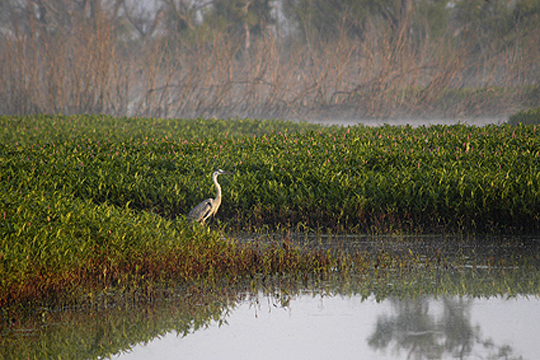
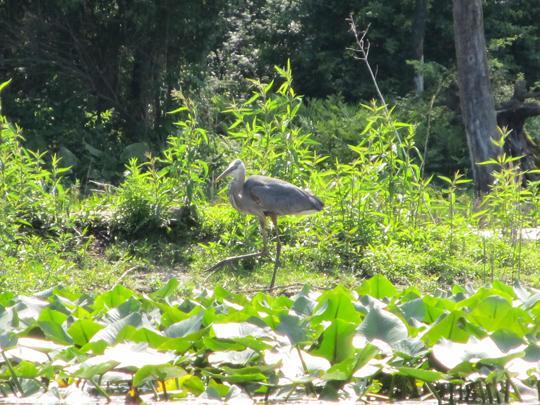
We’re into herons around here this week. We saw no less than 6 of them at a nearby pond we visited the other day, and it sparked enough interest to read every word of this book by Bill Ivy, one of a series the girls are in the habit of selecting from every week.

Because of the opportunities we’ve had to observe herons, we found this book to be interesting, though it’s pure nonfiction. It even gave me something to look forward to about the fall, which is approaching all too quickly: when the leaves come down, we can look for heron nests. With as many of them around as we saw the other day, I’m pretty sure we should be able to see at least a few nests.

Another heron story is in Thornton Burgess’s The Adventures of Grandfather Frog, in which Long Legs the Great Blue Heron almost catches Grandfather Frog for breakfast. There we learn all about his patience as a hunter and feel the thrill of the drama! Long Legs actually has his own full book (pictured here), but we haven’t gotten ahold of a copy.

We sat down together to draw some herons in action, using photos we’d taken on our recent field trip. Here are the fruits of our labors, based on the sight of a heron coming in for a landing.

Younger Daughter's drawing

Older Daughter's drawing, modeled after a slightly different photo

My drawing

I like that we drew together. It’s something I always mean to do but never get to.

For more read-aloud posts, visit Read Aloud Thursday at Hope Is the Word.

Girls Who Looked Under Rocks

I was pretty tickled to discover Girls Who Looked Under Rocks: The Lives of Six Pioneering Naturalists, written by Jeannine Atkins. It includes short biographies of Maria Merian, Anna Comstock, Frances Hamerstrom, Rachel Carson, Miriam Rothschild, and Jane Goodall. Since we’re using Anna Botsford Comstock’s Handbook of Nature Study as a key science text this year, it was a real treat to be able to introduce my daughters to her by reading something about her life.

Her story is, like the others in this book, an inspiring one that testifies to the impact passion, determination, and conviction can have on the world. Here we learned of her fascination with insects, as well as her intelligence and achievement as one of the first women to attend Cornell University and, later, become a faculty member. We also learned how her Handbook of Nature Study came about, and some of the obstacles she overcame in writing it.

This is classed as a Young Adult book, but my daughters are 7 and 10 and they had no problem with the chapters we read together. (I haven’t read all of them yet, but with the completion of each one we’ve read they’ve immediately wanted more.) If you have a budding naturalist (particularly a female one), this is a great book to know about.

Read Aloud Thursday: Trees

We’ve enjoyed three amazing books about trees this week.

Ancient Ones: The World of the Old Growth Douglas Fir is a beautifully illustrated, calligraphied, wonderfully informative book by Barbara Bash. The detail is amazing: wildlife among the living trees, creatures thriving in the dead ones and the process of decomposition, the beneficial effects of a forest fire, the requirements of a new seedling. All of this factual information is wrapped in a narrative that creates the hushed, listening atmosphere of an old growth forest.

Jason Chin’s Redwoods is another stunning discovery. It details the wonder of the coast redwoods, traveling from roots to the intricate web of life supported in the canopy. I desperately want to drop everything and go to the west coast so the girls can see these magnificent trees. This is a winner in terms of both information and fun, as some of the illustrations have visual jokes and subtexts that the girls readily appreciated.

A Log’s Life by Wendy Pfeffer follows the creatures that live in an oak tree before and after it’s blown down, taking us through the stages of its decomposition. The illustrations by Robin Brickman are made from cut paper, giving the pages a textured, collage-like effect. It’s a visually striking, interesting book that leaves us marveling over the economy of nature.

I have a couple of projects in mind that I’d like to do with the girls involving trees, and these books have prepared the way perfectly. How about you? What has your family been reading this week? Share it in the comments, or write up a post and link to Read Aloud Thursday.

Hiawatha Island: Jewel of the Susquehanna

Hiawatha Island: Jewel of the Susquehanna focuses on the history of a quiet island near the town of Owego, New York. Written by the county historian Emma Sedore, this book relates the different chapters in the life of what is now a 112-acre nature preserve. Now it’s a quiet place, wooded, and inhabited by wildlife, including a family of bald eagles. It’s open to the public to explore, and occasionally guided tours are given.

But it has not always been this quiet. In different seasons of its history, it has been roamed by native Americans; a recreation site that boasted a large hotel and an international clientele in the summers, when people came from all over the world to dance, bowl, and partake of the unique ambience of island life; a farm that provided meat and vegetables for a local restaurant; and a privately owned getaway. This book relates the details large and small of each respective era.

I find the story most interesting as an account of an emerging ecological ethic. Throughout its history, the people of Owego had certain ideas about what the island should, and shouldn’t, be used for. They had no objection to its use as a resort and recreation center in the 1870′s. There was a general sense that the island belonged to all, regardless of whose name was on the documents of ownership. There was a pride, and a feeling of responsibility for it. But it wasn’t until a strip miner proposed to buy the property in the 1980′s that these values rose into articulate form. Galvanized by the prospect of losing the island and its history, people banded together and took out a loan to buy the island, worked for several years to pay it off, and transferred it to a local conservation and education center. It stands as both a reminder of human history and a wild habitat in its own right with a diverse population of plants and animals.

I like this story of a local problem, locally solved. And I find it encouraging that in an age when the behavior and ethics of industry often display such an indifference to the natural world on which they depend, we can see examples like this of ordinary people who value their place on earth and are willing to fight for its preservation.

Wetland Read Alouds

We’ve been reading lots of books about wetlands this week, learning about the interrelationships in hopes of sharpening our observations at a local nature preserve. I didn’t have time to post yesterday, but I wanted to share a few of our discoveries anyway. I’m narrowing this post down to the top three books.

Squish! by Nancy Luenn pairs poetic impressions of a child’s wetland walk with gorgeous illustrations by Ronald Himler. There is plenty of information packed in as well, and we enjoyed seeing some of the same sights we’ve observed at our own freshwater wetland. It’s a perfect blend of beautiful text and pictures.

Here Is the Wetland, by Madeleine Dunphy, is written in a “house that Jack built” style to build a sense of the relationships among the wetland animals. It’s fun to read, especially toward the end when the list of animals following one another is quite long and I have to read through it at top speed to get it all in a single breath. The pictures by Wayne McLoughlin are absolutely glorious, so luminous that the light seems to radiate from each page.

Wetlands by Ronald Rood is a simple chapter book illustrated by Marlene Hill Donnelly. Like the other two books, it provides sensory description and a more thorough and comprehensive explanation of the plant and animal life in a wetland. I learned that a dragonfly nymph has an extendable jaw, that a damselfly holds its wings upright when it’s at rest, and that a mayfly’s above-water life is so short, many mayflies don’t even have a stomach. There are also instructions on how to build your own microscope. Very readable and informative.

You can see some pictures of our recent wetland explorations here and here. I totally missed yesterday’s Read Aloud Thursday, but for news about what other families are reading together, click the button below. Happy reading!