Birds and Blooms 2: Ferns

Bluets, with a tiny butterfly drinking

Okay, these aren’t ferns. They’re lovely though — tiny flowers sprinkled here and there in the woods.

But ferns are what we’re beginning to notice and learn about, and ferns are unfolding all around.

We saw these fern fiddleheads two weeks ago. We’ve seen this kind in two different locations. Each week, they’ve progressed, despite cold weather. Last week they opened their fists just a little.

This week, they developed still more, and this morning I tried to figure out what kind they were using the Handbook of Nature Study and the resources supplied in the More Nature Study Spring Outdoor Hour Challenges ebook. I’m pretty sure they are interrupted fern. Especially since seeing them yesterday, with their darker green pinnae covered with spore cases. The darker green sporangia will dry up and leave empty spots on the stem after the spores are distributed. I think they’re quite beautiful…

I’m not sure whether these ferns are all the same kind. The spore cases are light green in some (they look like clusters of grapes), dark green in others. Maybe the darker ones are further along; I think they turn brown eventually. Time will tell.

There are two other kinds we’ve seen too. One, I’m guessing, is bracken.

It was growing on a shaded creek bank.

The other species is still a mystery to me. It’s very delicate.

I’ve never paid that much attention to plants before; I’m more naturally drawn to critters and birds. But we’ve been enjoying our fern-hunting. It’s something to notice, the changes in the plants along the path — something to “read” that affirms the progress of spring.

Birds and blooms pt. 1

I’ve seen a few birds out and about lately. We’ve had a return to some chilly, overcast, damp weather that hasn’t been conducive to venturing into the great outdoors, but whenever possible we’ve tried to get out and enjoy some sun.

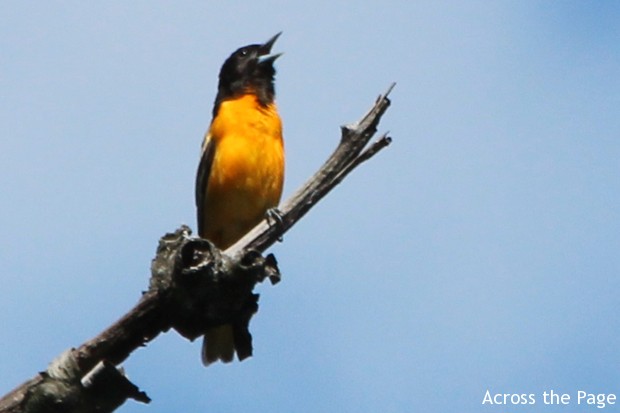
I’ll save the blooms part of my title for tomorrow — after I learn more about ferns. But here are some of the birds I’ve seen…


Male wood duck. My wood duck pics are almost always blurred for some reason, but this one comes close to focused.


I thought this might be a female red-winged blackbird, until...

...it squawked, revealing itself to be an immature male. Even dull-colored birds are beautiful with their feathers spread.

Here's a mature male, brightening an overcast landscape.

Female junco, hung out to dry.

Neighborhood Pavarotti.

Mockingbird -- best look I've gotten at one.

And then it flew away...

Yellow-bellied sapsucker. He pounded all day, trying to attract a female, and listened carefully for response...

"Anyone? Anyone?"

Older Daughter drew a cartoon of him in his lovesick spring state of mind.

I hope he found someone. We saw this female a few miles away. Maybe she came at his call.

There’s more to our schooling than nature study. Really there is. It’s just not as photogenic. India under the Moghuls, calculating the volume of rectangular objects, doubles-plus-one facts, lists of prepositions, dictionary skills, readings, and writing assignments just don’t seem… like subjects I care to revisit in this space. But the endless array of creatures around — new ones, and familiar ones appearing in new lights — are a different story. So many varieties, and so much to learn.

Hatch

It’s been an exciting few days at the Cornell hawk-cam. On Sunday, the first hatchling pipped its way out. Thousands of people watched as it worked all day trying to get out of its shell. Then a second egg pipped.

There was no sighting of the actual chick to signify completion of the task. Then Monday dawned snowy. It was kind of horrifying to see Big Red, who had apparently been entirely buried in snow at some points overnight, incubating in a snow fort. Not that snow is any surprise to a nesting upstate New York redtail… but what a day for a delicate hatchling to emerge into!

Finally, after a marathon period on the eggs, Big Red got a break when Ezra returned to the nest near 2:00, and viewers got their first glimpse of the new chick.

The second egg still hasn’t fully hatched, and no pip has been spotted on the third egg. Most of the excitement has been in watching the feeding sessions with the new hawklet. Amazing to see the tenderness of those large, fierce birds with their wobbly fluffball.

It’s been pretty captivating to watch. We’ve had the livestream feed on the computer most of the time so that we can keep tabs on what’s going on even as we go about our own daily business of feeding and teaching and “nesting.” As hawk fans and students of nature, it’s been a tremendous opportunity to see how another species meets the challenges of daily living with a devotion that’s nothing short of inspiring.

Nice job, Red and Ezra!

*Note: Images are screen captures I’ve gotten from Cornell’s web cam. Cornell encourages sharing, but to use such images commercially requires their permission.

Right place, right time…

Pileated nesting cavity

The girls and I were thrilled to discover a pileated woodpecker nest! Both adult woodpeckers were at the entrance when we caught sight of it. This is the male, and he is probably incubating the eggs. What a delight it will be to observe this tree over the next month!

Pond-erings

When the girls and I visited the pond at the university nature preserve earlier this week, a man was wading in the water, picking up trash. A woman was helping him, pointing out things from the bridge. He was a teacher there, and he picked up some of the critters in the water and held them out for the girls to see and touch.

I passed on touching the snake, but he pointed out that it had been bitten by something — probably a snapping turtle. He also explained that it was a female, and though it wasn’t poisonous, its saliva had an anticoagulant in it.

We saw a second one later. It’s striped, so maybe  it was a male.

I’ve never seen even one water snake before. It was noteworthy to see two in one day. He also picked up some salamanders and a big green frog for us to “meet.” Despite all the excellent resources available to homeschoolers, it was a real treat to be in the presence of a bonified expert who took the time to share some of his expertise with us.

The only sad thing: he found a dead muskrat in the water, one that appeared to have been shot. It probably explains why we see only one when we come, instead of the two we saw back in January. Who would shoot a muskrat? in a nature preserve? Much of nature study feels like we’re putting together a puzzle that makes more and more sense, but sometimes human behavior makes no sense in natural terms.

At the vernal pool we saw plenty of the usual suspects — frogs, salamanders, turtles, and eggs. The eggs had advanced from looking like this on April 2:

…to looking like this on April 16:

In both cases they remind me of tiny, submerged planetary systems. But they’re so much more advanced now.

This is such a great part of our nature study this year — visiting the same old places, and discovering the ways they are not “same old” at all. They change with the weather, with the seasons, with the time of day, with the attitude of the observers and how much we’re willing to look. It’s an amazing world we live in.

Yellow-bellied sapsucker


Spring rambling

We took another jaunt to Ithaca on Saturday. We didn’t see as much of the hawks featured in the nest cam this time, though we did look for Ezra hunting. We saw some other hawks hunting, and even a pair that were mating, over in the general direction he went when he left the nest. So the main thing we learned was that there are plenty of hawks around there! We also discovered an enormous pheasant farm that seemed to be an attraction for hawks — maybe for the mice and rats that hang around in hopes of stealing pheasant feed.

We checked on the herons as well. The male heron was on the nest when we got there, and as we watched, the female returned. He trumpeted his approval.

Then he set about gathering home improvements.

It was neat to see the different places around the pond where he gathered the sticks he brought. He made three trips while we were there, each time taking care to present the sticks to his mate and not just stuff them into the nest. The herons have been attacked by a great horned owl three different times now, and they seem to work together as a team quite well building and defending their homestead. They certainly have more human fans rooting for them than any other herons in the neighborhood.

There were other birds around as well, including white-throated sparrows. I think they’re exquisite, discreetly colored except for that dash of bright yellow, and their song is very sweet and lonesome. I associate it with the Adirondacks, one of the few places I ever go where I don’t hear traffic noise humming in the distance. To me they stand for wilderness… even though I saw them scratching up the earth under the feeders at the Cornell Lab. They are on their way through, heading north.

I also saw a bluebird — New York’s state bird!

Here are a few more sights that have made me smile lately. All of them suggest spring in some way, and all are fun to think of captions for. I’ll post them here without any further commentary…

Pontius Pileated and other woodland wonders

Finally some sun! The girls and I took advantage of it with a walk in the woods this morning. First we had to reach an agreement on where to go, and one daughter was not especially happy about the final vote. “We never see anything there,” she grumbled. “I’d rather go to the marsh and maybe we’d have a chance of seeing the pileated.”

“Maybe we can go there on the way home, if we feel like it,” I said.

Guess what was just about the first thing we saw?

Pontius Pileated himself! But wait — there’s still more! (Anyone remember the Ginsu commercials from years ago?)  This is the male — you can tell from the red sideburns. After studying us with that yellow eye, he flew off to a nearby tree and introduced us to his wife.

She wasn’t in quite such a mood for posing nicely, but it was a thrill just the same. And you know what it means. Where there is a Mr. and a Mrs., there will be youngsters. Somewhere, poking out of a big hole in a tree, will be little pileated beaks and little pileated squalls of laughter. So there’s our next woodland detective mission!

I’ve wanted a good pileated photo for so long that my day was made. But the woods had plenty more to reveal.

I saw an orange butterfly, and a black one, fluttering around the trees. There were woodpeckers of several varieties — a red-belly, a pair of downies making a racket, and a couple of hairies. While the girls played upstream, I sat on a rock and waited for a chipmunk to come back out from under its log, and got that feeling of being watched. As often happens in the woods, I discovered that while I was observing nature, it was observing me.

Mrs. Robin kept a wary eye on me all the while she bathed — so wary, I never did get a photo of her dunking her head. But she created a shower curtain of water droplets and seemed to enjoy all the splashing and fluttering.

I turned at a movement across the stream and got to watch a brown creeper spiralling its way up a tree. How about a game of Find That Bird? Can you see it in this photo?

Pretty cool, huh?

My poor camera can’t tell bark from bird.

We made a last stop at a favorite spot…

…and headed home for lunch.

A tree sparrow bid us goodbye.