A Circle of Quiet
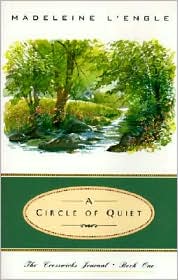 A Circle of Quiet is one of Madeleine L’Engle’s Crosswicks Journals. It’s the third one I’ve read; the others are Two-Part Invention and The Irrational Season. I found this one to be an enjoyable read, but harder to get my mind around. I came away with a sense of Madeleine L’Engle’s thought life during a particular season (always a worthwhile thing), but not as clear an understanding of the book’s main “statement” or topic. Of course I’m never sure whether that’s because of where I am as a reader, or because of the book.
Basically, this book is a series of reflections on the subject of “ontology”:
The burning bush… burned, was alive with flame and was not consumed. Why? Isn’t it because, as a bush, it was perfect? It was exactly as a bush is meant to be. A bush certainly doesn’t have the opportunity for prideful and selfish choices, for self-destruction, that we human beings do. It is. It is a pure example of ontology… the word about the essence of things; the word about being.
The “circle of quiet” in the title is the physical place L’Engle goes to beside the brook at Crosswicks to regain a sense of proportion. “Every so often I need OUT,” she writes,
My special place is a small brook in a green glade, a circle of quiet from which there is no visible sign of human beings… [There] I move slowly into a kind of peace that is indeed marvelous, ‘annihilating all that’s made to a green thought in a green shade.’
L’Engle takes this idea of a place where she’s restored to her true essence, so to speak, and plays with it in a variety of subjects: writing, art, faith, community. How do these things lose their “realness” under layers of fad or self-consciousness or market considerations or stodginess, and how do you get back to the truth — the unconscious, non-rational being — of them?
Now that I’m writing about the book, I guess I did get a sense of its overall direction. One of the virtues of writing — better focus! Which brings me to one of the things I value about the book: it has convinced me to journal again. Since blogging, I haven’t really kept a journal. I use up my quota of words here every day. But in some ways blogging just scratches the surface. It gives me the easy catharsis of words without the needed confrontation of the truly personal struggles going on underneath. That’s what journalling (for a writer) and prayer (for anyone) are for. L’Engle draws most of her material for the Crosswicks Journals — and, I suspect, a majority of her other writings — directly from her personal journals, where she records her thoughts and feelings and observations and reading. I’m going to get back to that discipline.
Another aspect of the book that I enjoyed was L’Engle’s musing on the subject of children, whose ontology/being is often less cluttered and more natural. I liked this passage especially:
The creative impulse, like love, can be killed, but it cannot be taught. What a teacher or librarian or parent can do, in working with children, is to give the flame enough oxygen so that it can burn. As far as I’m concerned, this providing of oxygen is one of the noblest of all vocations.
Good words for me, the frustrated housekeeper of a home where the “creative impulse” is alive and well — and strides through the place hurling legos, half-written books, clay creatures, pictures and the like everywhere. Kids need structure and discipline too, but without squelching that creative flame. (I’m thinking of scrawling “noblest of all vocations” on my vacuum cleaner.)
Throughout A Circle of Quiet L’Engle warns against taking things too seriously. Laughter is frequently mentioned and praised as a gift that returns us to sanity, and L’Engle laughs at herself often in these pages. There are more self-deprecating references to her own height or clumsiness or passionate nature than I remember in the other Crosswicks Journals I’ve read.
Overall I came away liking this writer even more. I’ve enjoyed a growing list of her books, and have admired her for her versatility and wisdom and imaginative reach. After reading this book, I realized how likable she must have been as a person.