The Irrational Season
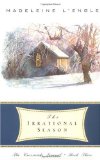 I picked up The Irrational Season on a whim off the library shelf, and it’s been a wonderful read for me. In fact, I’m going to have to purchase a copy so that I can underline and asterisk to my heart’s content (even though my husband is making jokes about me reading books on how to be irrational…).
This is the third book of Madeleine L’Engle’s 4-part autobiography, The Crosswicks Journals. I’ve only read the fourth one before, so it seems I’m moving backwards through them. In this one, L’Engle works her way reflectively through the liturgical year, exploring the connections between inner and outer spiritual seasons. She confronts some tough questions — about suffering, disillusionment with the institutional church, confusion and difficulty in understanding scripture or knowing God, sexuality and marriage, and even bouts of atheism, which she describes as “a virulent virus, put into the world by the Evil One for our destruction, and I come down with it as on occasion I come down with the flu.” (That’s just one example of an honesty that I trusted and needed.) Her poetry is woven in throughout the book, and I found many gems. Here’s one example (warning, by the way — this is a long post):
Sometimes in this groping dark of knowing my not-knowing
I am exhausted with the struggle to believe in you, O God.
Your ways are not our ways. You sent evil angels to the Egyptians
and killed countless babies in order that Pharoah –
whose heart was hardened by you (that worries me, Lord)
might be slow to let the Hebrew children go.
You turned back the waters of the Red Sea
and your Chosen People went through on dry land
and the Egyptians were drowned, men with wives and children,
young men with mothers and fathers (your ways are not our ways),
and there was much rejoicing, and the angels laughed and sang
and you stopped them, saying, “How can you laugh
when my children are drowning?”When your people reached Mount Sinai you warned Moses
not to let any of them near you lest you break forth and kill them.
You are love — if you are God — and you command us to love,
yet you yourself turn men to evil, and you wipe out nations
with one sweep of the hand — the Amorites and the Hittites and the Perizzites –
gone, gone, all gone. Sometimes it seems that any means will do.
And yet — all these things are but stories told about you by fallen man,
and they are part of the story — for your ways are not our ways –
but they are not the whole story. You are our author,
and we try to listen and set down what you say, but we all suffer
from faulty hearing and we get the words wrong.One small enormous thing: you came to us as one of us
and lived with us and died for us and descended into hell for us
and burst out into life for us — :
and now do you hold Pharoah in your arms?
(She doesn’t give titles of her poems, but the ones I’ve been able to track down reveal that she quotes only excerpts. I’m assuming this is a fragment too and therefore okay to quote here.)
There were several aspects of the book that particularly spoke to me. I very much like her way of talking about marriage without stereotyping roles. I appreciated her willingness to struggle, and to be honest about her struggles (which invariably get her somewhere, and don’t stall out in self-pity). I liked her discussions of community, of art, of her own writing life, of the different ways of knowing. She writes in the 1970’s, but much of what she observes about the idolization of rationality and the breakdown of community have come to full fruition.
But I think that what I needed most to read was her insistence that we need to be whole people. She compares us to Mercury with its extremes of hot and cold, its “sunside and nightside.” We have our conscious, rational minds, and we have our unconscious. She writes,
The unconscious aspect of the personality is anything but inert, and this is why it is so fearsome… When we limit ourselves to our ego-consciousness, then we close off that part of us which is capable of true prayer, poetry, painting, music. When we embrace the monster it may indeed devour us, and this is the genuine risk. It may also turn out to be the handsome prince or the beautiful princess for whom we have been waiting all these years.
It is only when we recognize and call by name all that we have relegated to the dark side of Mercury, to the deep black waters of the subconscious mind, that we have any hope of wholeness.
There are times in this book that L’Engle sounds like a universalist. Lewis was accused of universalism, and at times when I was reading Buechner back in the fall I felt uneasy about the same thing. All I can conclude is that brilliant minds trying to give full consideration to God’s grace are going to sound like universalists at times — and maybe God himself is less exclusive than our “sunside” will recognize when we see him face to face.