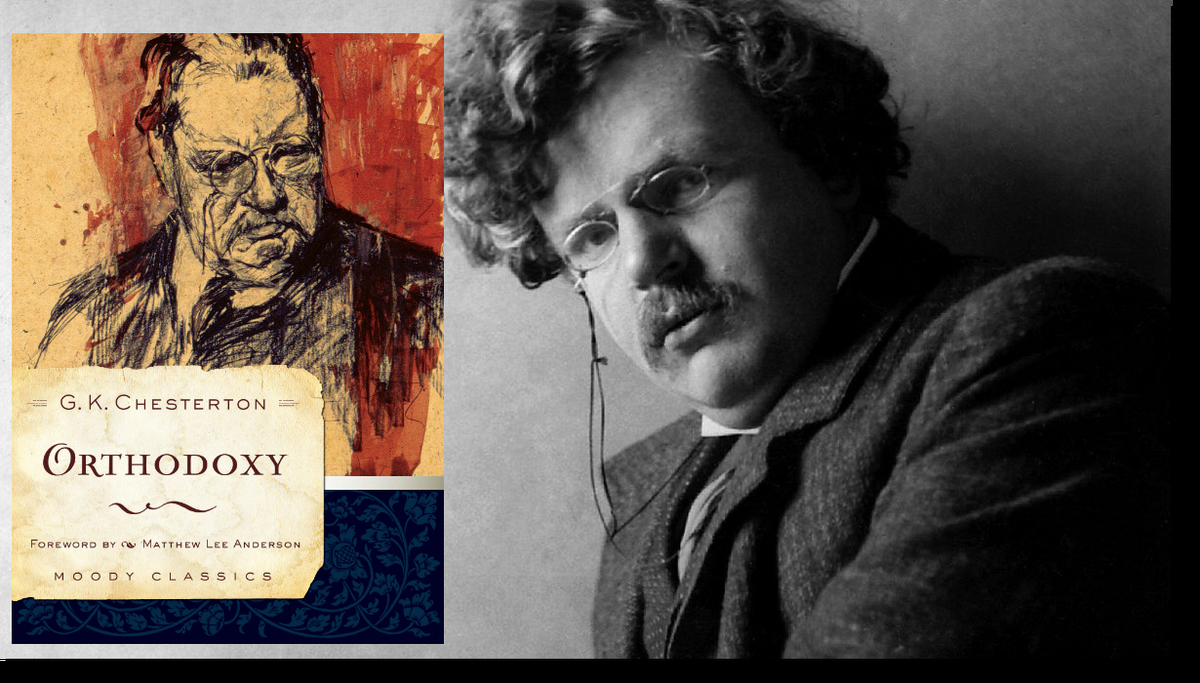
G.K. Chesterton on “tired democracy”

Do we think of democracy as the pinnacle — the culmination of long striving toward a fuller expression of human ideals — the summit of human progress?

G.K. Chesterton, writing in 1925, points out that such a view may have it backwards:

If there is one fact we really can prove, from the history that we really do know, it is that despotism can be a development, often a late development and very often indeed the end of societies that have been highly democratic. A despotism may almost be defined as a tired democracy. As fatigue falls on a community, the citizens are less inclined for that eternal vigilance which has truly been called the price of liberty; and they prefer to arm only one single sentinel to watch the city while they sleep. (The Everlasting Man)

America is only a couple of centuries old, but when you consider the consolidation of power in this country, and the various ways we hand over our freedom and privacy, it appears fatigue has set in already.

Pathological — or “normal”?

In my study of growing up in a networked culture, I meet many children and teenagers who feel cast off. Some have parents with good intentions who simply work several jobs and have little time for their children. Some have endured divorce — sometimes multiple divorces — and float from one parent to another, not confident of their true home. Those lucky children who have intact families with stable incomes can experience other forms of abandonment. Busy parents are preoccupied, often by what is on their cell phones. When children come home, it is often to a house that is empty until a parent returns from work.

For young people in all of these circumstances, computers and mobile devices offer communities when families are absent. In this context, it is not surprising to find troubling patterns of connection and disconnection: teenagers who will only “speak” online, who rigorously avoid face-to-face encounters, who are in text contact with their parents fifteen or twenty times a day, who deem even a telephone call “too much” exposure and say that they will “text, not talk.” But are we to think of these as pathologies? For as social mores change, what once seemed “ill” can come to seem normal. Twenty years ago, as a practicing clinical psychologist, if I had met a college junior who called her mother fifteen times a day, checking in about what shoes to buy and what dress to wear, extolling a new kind of decaffeinated tea, and complaining about the difficulty of a physics problem set, I would have thought her behavior problematic. I would have encouraged her to explore difficulties with separation. I would have assumed that these had to be addressed for her to proceed to successful adulthood. But these days, a college student who texts home fifteen times a day is not unusual.

High school and college students are always texting — while waiting in line at the cafeteria, while eating, while waiting for the campus shuttle. Not surprisingly, many of these texts are to parents. What once we might have seen as a problem becomes how we do things. But a behavior that has become typical may still express the problems that once caused us to see it as pathological. Even a typical behavior may not be in an adolescent’s best interest.

It’s a good question: is using technology this way pathological, or normal — or both?

It’s interesting that Sherry Turkle would get to this question on page 178 of Alone Together, because as I’ve been reading I’ve been remembering my own high school years. I can tell you right now that I would have been driven off a cliff if I’d been expected to “talk” — text, email, whatever — as continuously and excessively as today’s teens, by all accounts, do.

More to the point as I’ve thought back to high school, I’ve considered how back then I had some problems relating and growing up, and they expressed themselves in a way that was undisputedly pathological: an eating disorder. As I’ve been reading about the kinds of insecurity experienced by teens tethered to their social media and cell phones, I’ve  thought, “Why doesn’t this have a name? — Technology Disorder, or Facebook Nervosa, or… something? How is this not unhealthy and damaging to the development of a mature self?” And I’ve remembered a discussion last spring in which a high school senior told me that without Facebook, her “life would be ruined.” But if someone’s sense of self is that fragile — is it ruined already?

Then again, maybe it’s not fair to focus just on teens. Here’s one more excerpt, this one from page 160:

We may begin by thinking that emails, texts, and Facebook messaging are thin gruel but useful if the alternative is sparse communication with the people we care about. Then, we become accustomed to their special pleasures — we can have connection when and where we want or need it, and we can easily make it go away. In only a few more steps, you have people describing life on Facebook as better than anything they have ever known.

Week in Words: Glory

I’m pausing in my swim through the archives, lifting my head out of old blog posts for a breath of air in the present. And what I’m reading is 1000 Gifts: A Dare to Live Fully Right Where You Are by Ann Voskamp.

Her writing reminds me a lot of Annie Dillard, and also of Dillard’s predecessor, Thoreau. Especially this passage I read this morning:

How I want to see the weight of glory break my thick scales, the weight of glory smash the chains of desperate materialism, split the numbing shell of deadening entertainment, bust up the ice of catatonic hearts. I want to see God, who pulls on the coat of my skin and doesn’t leave me alone in this withering body of mortality; I want to see God, who gives gifts in hospitals and gravesides and homeless shelters and refugee camps and in rain falling on sunflowers and stars falling over hayfields and silver scales glinting upriver and sewage floating downriver.

It’s a very similar sentiment to what Thoreau expresses here, in Walden:

I went to the woods because I wished to live deliberately, to front only the essential facts of life, and see if I could not learn what it had to teach, and not, when I came to die, discover that I had not lived. I did not wish to live what was not life, living is so dear; nor did I wish to practise resignation, unless it was quite necessary. I wanted to live deep and suck out all the marrow of life, to live so sturdily and Spartan-like as to put to rout all that was not life, to cut a broad swath and shave close, to drive life into a corner, and reduce it to its lowest terms, and, if it proved to be mean, why then to get the whole and genuine meanness of it, and publish its meanness to the world; or if it were sublime, to know it by experience, and be able to give a true account of it in my next excursion. For most men, it appears to me, are in a strange uncertainty about it, whether it is of the devil or of God, and have somewhat hastily concluded that it is the chief end of man here to “glorify God and enjoy him forever.”

Both writers feel something so similar when they’re out in nature, yet they come to such different conclusions about God. I also notice the contrast between a feminine perspective that absorbs the wonders of nature, and a masculine one that seeks to dominate (“drive life into a corner”).

Both passages stir me up and encourage me to go into this day alert to the possibilities. As Ann Voskamp goes on to say, “I pay tribute to God by paying attention.” I hope this will be a digging-deep, thick-scale-breaking, skin-coat-tugging kind of day.

Chesterton’s advice to writers

Some passages just need to be shared. This one is from the chapter “The Romance of Orthodoxy” (in Orthodoxy). Chesterton is on his way to a larger point, but I have to stop and smile here for a bit:

Most of the machinery of modern language is labour-saving machinery; and it saves mental labour very much more than it ought. Scientific phrases are used like scientific wheels and piston-rods to make swifter and smoother yet the path of the comfortable. Long words go rattling by like long railway trains. We know they are carrying thousands who are too tired or too indolent to walk and think for themselves. It is a good exercise to try for once in a way to express any opinion one holds in words of one syllable. If you say “The social utility of the indeterminate sentence is recognized by all criminologists as a part of our sociological evolution towards a more humane and scientific view of punishment,” you can go on talking like that for hours with hardly a movement of the gray matter inside your skull. But if you begin “I wish Jones to go to gaol and Brown to say when Jones shall come out,” you will discover, with a thrill of horror, that you are obliged to think. The long words are not the hard words, it is the short words that are hard.

Off to a day of one-beat words…