The Man Who Listens to Horses
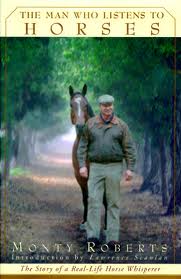 My husband gave me The Man Who Listens to Horses: The Story of a Real-Life Horse Whisperer when we were dating. (We’ve been married ten years.) I read most of it, and this week I went back through it again all the way to the end.
Apparently there’s some controversy about the book. Some of its factual claims are disputed: did Monty Roberts really do the stunt riding in National Velvet? Was he really a protege of Bill Dorrance — who has said he doesn’t know him? Was his father really the hard, cruel man depicted in these pages? I can’t say that these accusations didn’t affect me. They did make me more skeptical. I also felt Mr. Roberts may inflate his own importance when he presents himself as a champion of a “new way” of training horses. Surely there have been true horsemen for centuries, men who love these animals and practice “natural horsemanship” with or without its official title.
Nevertheless, the book had an impact on me. There’s no question about whether this author knows how to work with horses cooperatively rather than cruelly, in ways that build trust rather than fear. And whether or not his father is guilty of beating Monty repeatedly with a chain, or disarming and then killing a hold-up man with his bare hands, the photographs in the center of the book make it plain that his father did indeed train horses by tying them up with ropes and using other methods of intimidation.
It’s hard to read about the abuse horses have been subjected to by their human stewards. That type of thing is what I find most difficult about animal stories and movies in general. This book calls forth mixed emotions: sorrow and grief blended with delight that the sensible, successful, and humane training methods Roberts describes here are recognized and respected by a growing number of people.
I find it fascinating to read about horse behavior. Though Roberts identifies them as flight animals at the far opposite end of the spectrum from their more aggressive human counterparts, in our basic psychology our two species have some real similarities. Horses and people respond to inner and outer wounds, and mistreatment by others, in the same way: retreat and loss of trust. And like humans, they can find healing only through learning to trust someone and work through their fears together.
This book is filed in my mind alongside Cloud: Wild Stallion of the Rockies, filmmaker Ginger Kathrens’ marvelous portrait of the mustangs in the Arrowhead Mountains of Montana. We’ve read a number of horse stories in this house, but these two works distinguish themselves as studies of horse communication and behavior. We’ve also enjoyed Leslie Desmond’s Horsemanship for Children video from the library. I’d probably put the videos above this book if I had to rate them, but the type of information, and the lines of thought it inspires, are similar.
In any case, this book has the double value of feeding my own interest in horses, and contributing to the dialogue between me and my horse-loving daughter. I’m sure my husband had no idea it would eventually touch the hearts of two ladies.