The Doors of the Sea
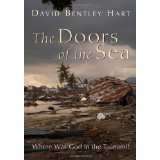 David Bentley Hart’s The Doors of the Sea: Where Was God in the Tsunami? is a short (104 pages), challenging, in many ways satisfying theological discussion of the problem of evil. Recently I’ve read reviews by some bloggers I respect, and I was intrigued enough to buy a copy and read it this week.
The argument itself is satisfying in the sense that it articulates the struggle any thinking person has when we look at the world, see its brutality on a grand, impersonal scale, and try to reconcile it with a good, loving God. I don’t think I’ve ever read such a full-throated description as this from a Christian perspective:
It is as if the entire cosmos were somehow predatory, a single great organism nourishing itself upon the death of everything to which it gives birth, creating and devouring all things with a terrible and impassive majesty. Nature squanders us with such magnificent prodigality that it is hard not to think that something enduringly hideous and abysmal must abide in the depths of life.
One of the reasons we read is for passages like that, which affirm our own feelings but then — as this book does — move us beyond them as a map can help us find our way out of a dead end.
I felt something similar after reading Lewis’s Problem of Pain. It’s not identical, but it covers a fair amount of the same ground, and it’s equally satisying in its acknowledgment that nature as we experience it has never been the ground of religious faith; we’re not supposed to look at pain and suffering as evidence of God’s goodness, or his chosen materials for bringing his purposes to pass. But where Lewis’s book is directed primarily at skeptics (his aim is to “show that the old Christian doctrine of being made ‘perfect through suffering’ is not incredible. To prove it palatable is beyond my design”), Hart’s is aimed equally at the careless and often callous arguments of professing Christians. In that sense this book shows itself to be a work of a different age — an age when the Christian mind is under attack on all sides (including the shunning of rationality in some quarters of Christianity itself), and those who can give voice to a Christian worldview in what Nancy Pearcey would call the “public square” are needed both to elucidate and to exhort.
This book is an expansion of a Wall Street Journal article Hart wrote shortly after the tsunami in Asia in 2004. Hart himself is an Eastern Orthodox theologian and teacher, and there’s plenty of instruction packed between the covers of even this short book. I liked the way Hart laid out arguments by atheists against God, by deists as apologists for God, and by professing Christians responding to the tsunami. I liked the way he examined and exposed the fallacies of these arguments. Most of all I liked the way he disentangled the God of Scripture from the various ways he’s been mischaracterized by foggy theology, anthropomorphism, and faulty thinking. I have, I think, a clearer picture of who I’m praying to now; the glass is a little less cloudy. A passage like this gives a whiff of Hart’s final resting place in the argument he’s making, and from me it calls forth an amen. Central to the Gospel, writes Hart, is
the evil of death, its intrinsic falsity, its unjust dominion over the world, its ultimate nullity; the knowledge that God is not pleased or nourished by our deaths, that he is not the secret architect of evil, that he is the conqueror of hell, that he has condemned all these things by the power of the cross; the knowledge that God is life and light and infinite love, and that the path that leads through nature and history to his Kingdom does not simply follow the contours of either nature or history, or obey the logic immanent to them, but is opened to us by way of the natural and historical absurdity — or outrage — of the empty tomb.
The only thing about the book that I haven’t come to terms with yet is its intellectual showiness. Many of the reviews at Amazon complain that the book’s language is so erudite as to be inaccessible. I wouldn’t go quite that far. But Hart’s vocabulary seems needlessly sophisticated — distractingly so. It made me wonder if there’s a subtext of “I am smart” in reaction to the condescension of some of the atheistic pronouncements made in the aftermath of the tsunami.
When it comes to intellect, Christ himself takes the prize. As Dallas Willard points out, Jesus “is not just nice, he is brilliant. He is the smartest man who ever lived.” Yet his method was not to dazzle with his erudition. He walked and ate and camped and performed miracles and opened the glories of his Kingdom among uneducated people, working class people, people who certainly had not read Thomas Aquinas or The Brothers Karamazov. My liking for this book is tempered by a mistrust for its intellectual glitter and its tone of (sometimes scornful) impatience. These could very well be traits that mark Hart as a prophetically gifted thinker. But they work against the life-giving quality of some of his insights here, and make the book less palatable to me than if it were narrated in a spirit of humility.
Edited to add: For further reading, here’s an interview with David Bentley Hart.